Upgrading Your Creative Tools: Breaking the Habit Loops That Quietly Limit Your Vision
Why evolving your design process isn’t optional—it’s energetic alignment in action
Your Tools Are Talking Back
There’s a subtle moment every creative hits—when the tools that once felt empowering start to feel… predictable.
Not broken. Not useless. Just too familiar.
You open your design software, reach for the same grid, the same font pairing, the same workflow rhythm—and without realizing it, you’ve already decided what the outcome will look like before the first pixel lands.
That’s not efficiency. That’s a loop.
And loops, when left unchallenged, quietly become creative ceilings.
Section 1: The Comfort Trap Disguised as Mastery
Mastery feels good. It’s smooth, fast, reliable. But there’s a shadow side to it: repetition without evolution.
Outdated design habits rarely announce themselves as “outdated.” They show up as:
Overused layout structures that once felt innovative
Default color palettes that no longer stretch emotional range
Rigid workflows that prioritize speed over exploration
What’s really happening here is energetic stagnation. Your creative system is recycling known frequencies instead of generating new ones.
Design, at its core, is frequency translation—turning internal vision into visible form. When your tools and habits stay static, your output can only echo the past version of you.
And if you’ve grown (which you have), that echo starts to feel misaligned.
Section 2: When Tools Become Filters Instead of Portals
Creative tools are meant to expand perception—not narrow it.
But outdated habits turn tools into filters. They begin to decide for you:
“This is how a brand layout should look.”
“This is the safest typography pairing.”
“This is what clients expect.”
These assumptions aren’t facts—they’re residues of old creative environments, past trends, or even past versions of your own identity.
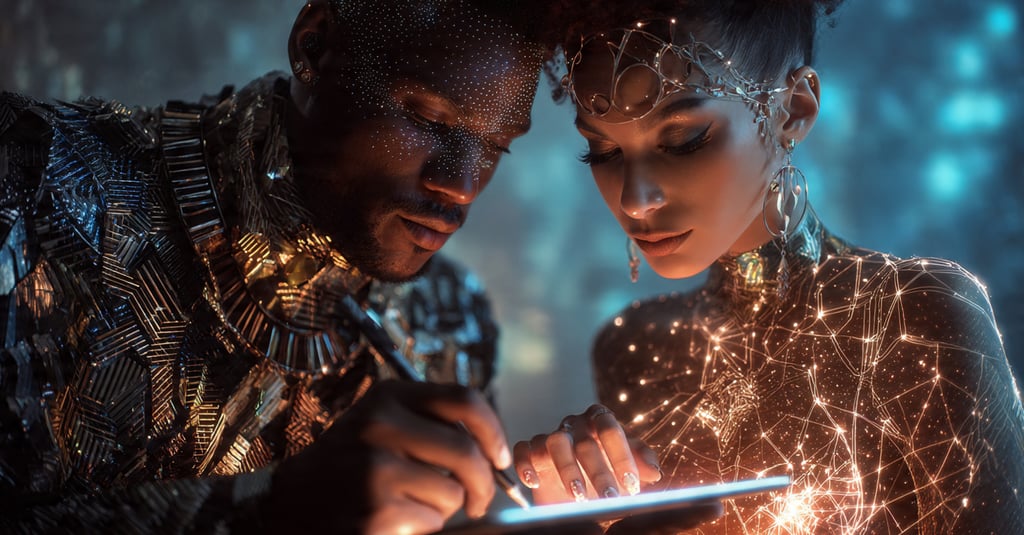
The shift happens when you stop treating tools as fixed systems and start engaging them as responsive collaborators.
This is where AI enters—not as a replacement, but as a pattern disruptor.
AI doesn’t carry your habits. It doesn’t default to your comfort zone. It introduces unfamiliar geometry, unexpected compositions, and new visual languages that can wake up your creative instincts.
Not because it’s “better,” but because it’s different.
And difference is where evolution lives.
Section 3: Upgrading Isn’t About More—It’s About Resonance
There’s a misconception that upgrading your creative tools means adding more complexity: more plugins, more software, more techniques.
But real upgrades are about resonance, not accumulation.
It’s asking:
Does this workflow still reflect how I think today?
Does this tool expand my imagination—or contain it?
Am I designing from curiosity or from habit?
Sometimes the upgrade is external—new tools, new tech, new systems.
But often, it’s internal:
Letting go of the need to be efficient all the time
Allowing space for experimentation without outcome pressure
Breaking your own “rules” just to see what happens
That’s where new creative energy enters. Not from doing more—but from doing differently.
Section 4: Designing Beyond Your Past Self
Every designer has invisible templates—mental blueprints shaped by past work, past trends, and past validation.
Upgrading your creative tools means outgrowing those templates.
It means creating work that your old self wouldn’t have made.
That might feel uncomfortable at first. Less polished. Less predictable. Maybe even less “safe.”
But it’s also more alive.
Because when your tools evolve with you, your work stops being a repetition of what you know—and starts becoming an exploration of what’s possible.
That’s the shift from design as execution… to design as expansion.
Oracle Closing: The System Update Is You
Outdated habits aren’t failures—they’re evidence of who you used to be.
But staying in them too long creates friction between your current vision and your creative output.
Upgrading your tools isn’t just about software or technique—it’s about energetic alignment.
It’s about choosing growth over familiarity. Curiosity over control. Expansion over repetition.
So the next time your workflow feels a little too easy, a little too predictable…
That’s your signal.
Not to work harder—but to evolve the system you’re creating from.
If this resonated, take a moment today to disrupt one small part of your creative process—change the structure, flip the palette, invite a new tool into the conversation. You don’t need a full reset. Just a new frequency to build from.
Shae Digital LLC | 2026 |All rights reserved ©
Top rated by 30+ clients
★★★★★